Showing posts with label Family history. Show all posts

Wednesday, 14 March 2018

Savouring Memories

Six years ago I wrote a post here about my collection of recipes handed down, shared and cooked by my grandparents, parents, friends, relatives  and colleagues - all with their own unique memories. My sister Helen came up with an idea a few years later about writing a book about recipes from the past.  Well it sounded a good idea at the time and my sisters and I got excited at the prospect of possibly publishing a book that could be handed down to future generations, but it didn't happen - life often gets in the way of good ideas and so it was forgotten about, abandoned.

However, it has always been there in the background for me and as a maker of Journals over the years I decided to turn this idea into a Journal for myself not only about the recipes but incorporating  kitchens of the past and the gadgets, utensils and kitchen paraphernalia that housewives have used over the years, me included (I have always been a sucker for new gadgets which often lay at the back of a cupboard for years before they see the light of day again).


So, armed with all my old recipes and cooking ephemera and a huge amount of research I set about making the Journal. The cover was from an old hardback book that I gutted (sorry book lovers but it was found in a charity shop and destined for book heaven anyway). I covered the front and back covers and then joined it together with rings.  I generally make my own signatures and sew them into a cover but for this purpose it was easier using rings as I was, and am still able to add other items as I go along.


I found photos of old cooking utensils and copied lots of my old cookery books and food advertising that go back for 70 plus years, to the time of my grandmothers' kitchens.


I've been busy making tucks and pockets, banners and labels in order to facilitate all my ephemera. 


Inside the actual journal I am adding a further three mini journals/signature that I have made, to cater for the many scraps of paper/recipes that I have collected since I married 48 year ago. This has evoked so many happy memories - like the shoe shop receipt for my daughter's first pair of Clarke's shoes aged 4 year old in 1977 - with a recipe hastily written on the reverse. The shoes by the way cost a mere £4.49!


Then there's memories of the Peanut butter and other cookies and jotted down on an American friend's scribble pad. I only knew her for 18 month before she returned home to the USA and now sadly lost touch.


This has been such an exciting venture for me and evoked so many happy memories. Each scrap of paper/recipe/photo has a story to tell. It certainly kept me busy during the dark dreary winter months and delighted I have something to show for it. I'll be hand-writing and using my old vintage typewriter on occasions for making my Journal entries.


And who remembers the days of Hostess trollies, fondue sets and pressure cookers let alone the electric carving knife, wall can openers, choppers, mandolin slicers  - to name but a few, although I'm sure many of these are still found in households today. And then of course there was the introduction of the deep freezer into our homes in the late 1960s which then was a revolution but one we couldn't be without today!


So, the adventure carries on. This is definitely a work-in-progress and each day I'm finding and adding new ideas all the time. Whilst I can't take credit for Helen's original idea, it certainly gave me food for thought (no pun intended!)

Be back again soon P x


Monday, 5 January 2015

A family heirloom

In 2001 I signed up for a two year City and Guilds course called Victorian Heirlooms, where we learnt how to re-create many Victorian crafts and techniques as well as learning about 19th century history and famous people alongside it. The Pre Raphaelites, The Arts and Crafts Movement including William Morris, William de Morgan. Authors such as Lewis Carroll and Charles Dickens; designers and gardeners Edwin Lutyens, Paxton and Gertrude Jekyll to name but a few. Fabulous course which has stayed with me forever.

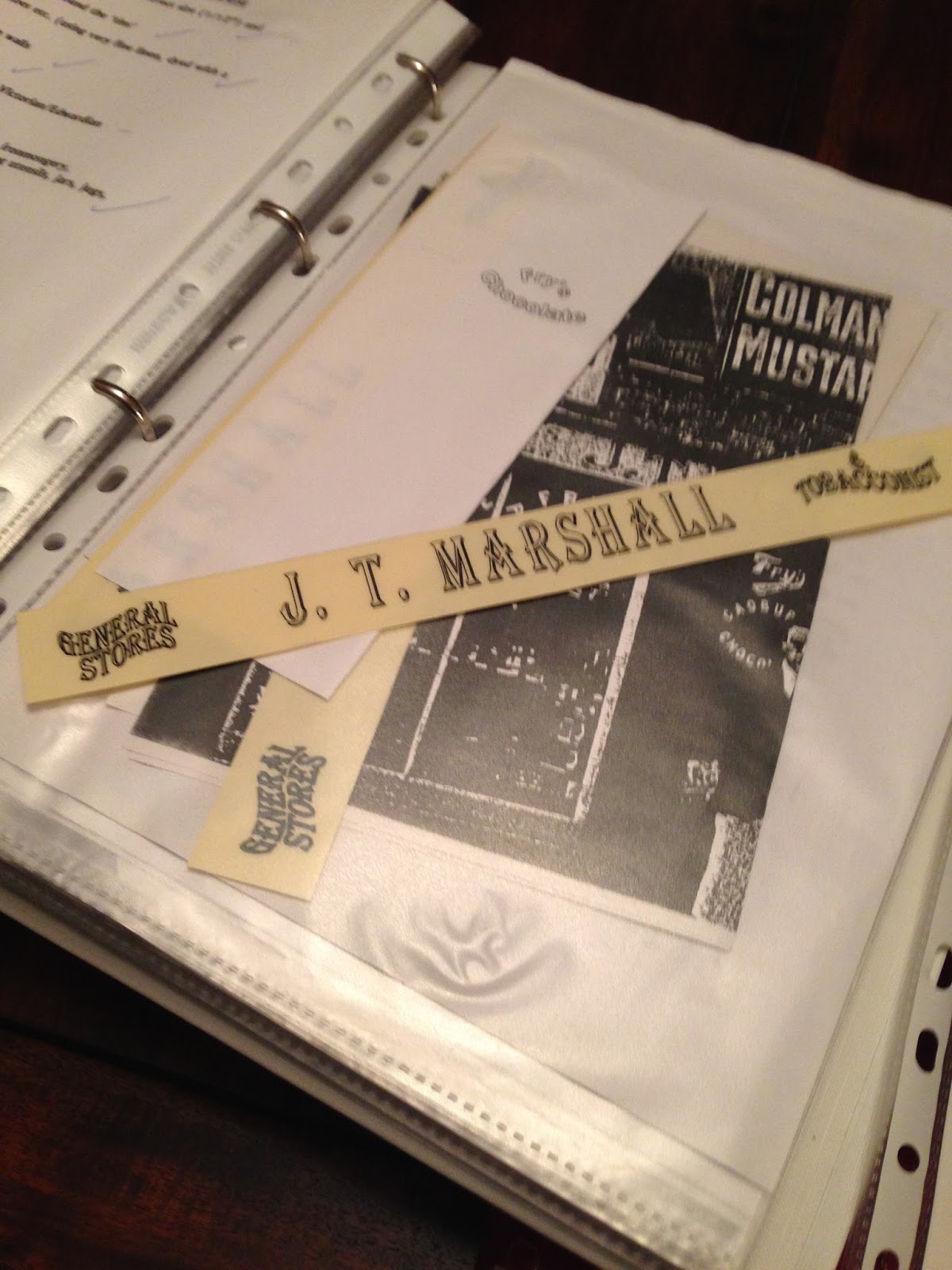
As a final piece of work we had to produce an heirloom using many of the techniques we had used during the course such as embroidery, paint effects, ageing and distressing paper, wood and fabric. I decided on a doll house but one with a difference as it was to be a shop and this shop would be a replica of John's grandfather's shop he owned in Histon, Cambridgeshire in the early 1900s named J.T. Marshall - General Stores and Tobacconist.

I bought the house which I had to put together and paint, tile the roof, added chimney pots, plastic windows with adverts on, put up shelves and skirting boards, laid fake linoleum to the floors, lighting and so on and so forth. It was fun and I spent many hours and many pennies furnishing the shop area with suitable pieces to scale.


(please excuse the quality of the photos - I had to take pictures of photos in my folder)


I tried to replicate it as much as I could from this one photo


It was very fiddly trying to put all the groceries out on show. 
I made all the fruit and bread with a polymer clay


 and also all the sacks and carrier bags from paper and linen


as well as the shop sign and adverts for the windows

After my coursework and the house/shop project was completed (which I passed) it went up into our loft. I didn't have time to complete the house part as I was going on to do my History degree and simply didn't have the time.

So, what to do with this now you may ask. Well my three youngest grandchildren who carry on the family name aged 8, 5 and 2 years old have just taken possession of their great, great grandfather's shop together with a potted history of his life.


 It was a picture on Christmas afternoon to see their faces when I uncovered it -


and a delight to know it will remain in the family for the foreseeable future.


Have you got any heirlooms to pass down to future generations?

Have a good week.


Wednesday, 4 September 2013

The French connection

Hello to you all and thank you for all your lovely comments on my last (two weeks ago) post. I don't know where the time goes.

I must be honest I'm quite looking forward to the Autumn now. The new school year has begun and I can get back into a routine. The school run certainly gets me going in the morning and it's good to plan my week ahead. John is now semi retired - working three days a week so our time is shared between things that need doing against things we want to do and therefore plans are afoot to make for a smooth transition.

In a recent post I touched upon my French connection and as several people wanted to know more I thought I'd fill you in with a bit of my family history.

 My grandmother Alice Aurelie Victorine Mercier 


was born and brought up in Valenciennes in 1899. Quite a small town compared to today's sprawling city in the Nord-Pas-de-Calais.

My grandfather, William Wells was in the Motor Cycle Corps of the Royal Engineers during the first World War. In actual fact he had an avid interest in motor bikes prior to signing up and the 1911 census tells us that at 17 years old he was a Motor Cycle Improver. Anyway he signed up in 1914 and because of his interest he was able to take his own motor cycle with him to become one of the first motor cycle dispatch riders with the Royal Engineers prior to which this duty was carried out on horseback. Based in Mons, Belgium his job was to take messages and documents to and from the front line. It was on one of these journeys that he must have passed through Valenciennes on his way back to Mons - about 20 miles away.


Now - my grandmother Alice's parents owned a Boulangerie Patisserie shop in the Rue de Quesnoy in Valenciennes and it can only be surmised that William met Alice when he walked into the shop to purchase some freshly baked bread perhaps.

Alice's father, Alphonse Romaine MERCIER was born in the area around 1865

and he met and married Victorine Elizabeth Marie CARON born 1865
(standing here in the cobbled courtyard behind their shop)


Not a lot is known about my great grandparents. To try and trace family in France is no mean feat, especially if you cannot speak the language! No not a word!!!

Many years ago my late mum gave me an old box with some very dirty silver spoons, which she told me came from her mother Alice. As per usual this got stashed away in my loft and moved from house to house over the last forty years. However, in one of my "lets sort the loft out" days, it got brought back down again. I attempted to clean the silver and at least four of them were engraved with some initials. Didn't think much about it until I started writing this post! I don't know if you can see clearly but the initials are a very ornate M and C - the surnames of my French great grandparents Romaine MERCIER and Victorine CARON. 


Again, I hadn't really  taken much notice of the box but when I took the spoons out I noticed a piece of dried heather and a dried rosebud. My guess is that this was a wedding present for Alphonse and Victorine when they married around the mid 1890s. A gift  possibly from one of their parents - who alas I know nothing about.


Anyway back to Alice and William. 


It is unknown whether William returned to England with his regiment or stayed behind but they courted for a few years before marrying in 1922 - firstly in the Hotel de Ville - the local town hall and then they went to their local Church the Notre-Dame-du-Saint-Cordon which looked quite a grand affair.


William took Alice back home to England where they settled in Middlesex. Mum was born in 1925 and shortly after, my Uncle Jack - the rest is history - for another day perhaps.

I hope you enjoyed this little story of my French roots.

See you soon x

Monday, 28 January 2013

The life and times of Granny Smith

I wonder if you might like to see a potted history of my Granny Smith. My sister Barbara and I have spent many years trying to track her story down.


I think she was about 60 here in 1933


Fanny Frances was born 'out of wedlock' in the Kensington Workhouse in 1873 so her birth certificate told us.  A stigma she must have carried with her all her life.  Illegitimacy was not good in Victorian London. Unwed mothers and their infants were an affront to morality. They were spurned and ostracized by the public relief and charitable institutions. If a young woman became pregnant while still living at home, she was forced to leave in disgrace and move into the workhouse or to an area where she was not known. Scorned by family, friends and employers alike.

We searched the Guardians' minute books at the London Metrolpolitan Archives and indeed found her mother Elizabeth Monet aged 17 in the Mary Place branch of the workhouse where she gave birth to Fanny in February 1873. It is not clear why they were in the workhouse. Perhaps through poverty or the parents disowned her because of the shame of pregnancy, who knows.
Fanny’s mother Elizabeth and grandparents Fanny and Peter were living in Notting Hill in very overcrowded conditions in streets of tightly packed houses where over the years with an increasing family they relentlessly moved from one set of crowded rooms to another paying about two shillings a week for the privilege. These conditions continued throughout Fanny's childhood.


The family consisted of several children and this may have been a reason why Fanny and her mother ended up in the workhouse. The children slept at least four, top-to-tail in one bed. Often there were another three or four families living under the same roof, where sanitary conditions were appalling and so encouraged rats to roam freely in the filthy and polluted streets.


This area of Pottery Lane historically had became known as “the Piggeries and Potteries” owing to the many pig-keepers and brick makers who had migrated from Ireland to Notting Hill during the 1840’s because of the potato famine.


During Fanny’s time this area was also known as “Laundry Land” because of the many hundreds of housewives including her mother and grandmother who had to take in washing and ironing for the families in the posh houses at the top of the hill in order to earn a shilling or two to help out with the family income. Alternatively they would take the laundry down to the Public Baths.


Kensington Public Baths 
 

When Fanny was three years old, her mother married a Mr Curtice, who became Fanny’s stepfather. Over the years, several more children were born, giving Fanny half brothers and sisters. The 1881 census shows a Fanny Curtice aged seven, living with her grandparents Peter & Fanny Monet in a street nearby. Whether Fanny had been living with her grandparents since her birth or maybe since her mother’s marriage is unknown. There may simply have been no room for her at home. An elderly aunt told me that it was not at all uncommon for the eldest child to live with grandparents at that time.

Fanny attended a local school which cost a penny a week. When she was 12 she was ‘put into service’ where she worked as a scullery maid doing very menial tasks including scrubbing the floors, stoves, sinks and dishes for a mere pittance of about one shilling a week and a room in the attic. She only had a few hours off each week.

In 1891 aged 18 she was working for a household in Earls Court Road where by now she had become a cook. In 1894 she met and married her husband Charles Smith. Fanny started life as a Monet, lived her life as a Curtice and upon her marriage discovered her father’s name was Shearman which appeared on her marriage certificate. She was known to never have any contact with her mother after her marriage and I wonder if she never forgave her for keeping her illegitimacy from her over the years, as well as never knowing who her father was until her wedding day. Fanny died in 1963 aged ninety years old.

Barbara and I have been to Notting Hill on several occasions and found some places of interest - but will leave that for another time.

Pictures by courtesy of The Story of Notting Dale.by Sharon Whetlor, 1998


I'd like to welcome my new followers - Kitty, Elisabeth, Annmarie, and Linda


Thursday, 6 December 2012

The life and times of Rose

Welome to my new follower Betty. It's lovely to meet you and hope you enjoy what you find here.
 
~~~~~~~~~~
 
With Christmas on its way and children eagerly awaiting their presents from Father Christmas, I thought I'd introduce you to Rose who has been in the family since Victorian times and was given to me at Christmas when I was five years old. Rose was made in Germany in the mid 1890s (she has a mark on the back of her neck) and made her way to a toy shop in France where she was given to my maternal grandmother who was born in 1899 in the town of Valenciennes, France
 

.

Alice, my grandmother was an only child of Alphonse and Victorine Mercier (born in the 1870s) and they owned the local Boulangerie in Valenciennes. During the first World War Alice met William Wells, my grandfather who was stationed in nearby Mons. They married in 1921 and moved to England where they had my mum Stella and my Uncle Jack. Mum remembers visiting her French grandparents every year and on one trip in 1931was given Rose to take back home with her and she had to be wrapped in a blanket for the rough ferry ride home.  There she stayed with the family for many years cherished and played with by my mum who would often take her out in a pram. On one such occasion she was spotted by the lady in the local wool shop and asked if Rose would 'model' some knitted toddlers clothes in the shop window. The customers loved her and she stayed there for several months.

Mum and dad married in 1946 and we moved to Canvey Island in 1950 where Rose was introduced to a new life by the sea and new friends. I too pushed her in my pram.

Her body is made of a kind of very hard papier mache which has been painted and glazed and her limbs are jointed and strung together, as is her head. She is 30 inches long and really isn't a baby doll at all. Us girls made a huge fuss of her - she was taken here and taken there;  shared with friends; taken to the shops - simply treated like another member of the family and at times was to be found plonked on top of a box of toys. She really wasn't treated too well I'm afraid - hence a few missing fingers and chipped paint on her limbs.


and her head is porcelain with real hair


After I married in 1970 she was sadly put in the loft. I brought her down about fifteen years ago to find that all the strings had rotted and she was literally falling apart. I sent her to a Doll's Hospital where she was put back together. My children weren't too keen on her - thinking she looked too human so she was once again relegated to the loft. One day no doubt she will be passed on to my grand daughters, who I'm sure will love her as much as I have.

Rose came down from the dreaded loft last weekend (she's been up and down like a yo yo over the years) and when I think of all she's gone through and how much she was played with for nearly 120 years my heart goes in my mouth. But she's come through it okay don't you think?

Have you got any family heirlooms you'd like to share?
 
 
Have a great weekend

Thursday, 10 May 2012

Dad's Army

I don't know if anyone saw the Channel 5 programme on Tuesday called "War Hero in my family". It's a programme a bit like "Who do you think you are" but it traces people's family members who took part in WW2. This week featured Ann Widdecombe's look into her uncle's military history in Tunisia. I was particularly interested in this as my own late father served in Tunisia too and it was good to have an insight into what it was like.

Dad had never talked about the war and all I knew was that he served in Tunisia; it was very hot and there were terrible problems with the sand and flies. He had also mentioned Sicily and Italy and I remember seeing some photos. Other than that I didn't have a clue.

This is Dad on the left possibly in Tunisia

Dad in the middle - possibly in Italy


About ten years ago I wrote to the Ministry of Defence to enquire if they had anything on their records that might be of interest to me. I was delighted to receive a plotted history of his service career. It was the best £20 I have ever spent as the information gave me lots to go on in my endeavour to see when and where he went. In the meantime I picked up this old paper/magazine at an antiques fair which helped with my research and what a find!


As a skilled engineer working with GEC Dad joined the Territorial Army prior to war breaking out and after initial training and going through the ranks he was eventually made up to Sergeant and posted to the newly formed Inspectorate in the REME (Royal Electrical Mechanical Engineers) where he was in charge of and oversaw the maintenance and day to day running of the tanks and other armoured vehicles.


He was posted to Tunisia on 8th November 1942 (not sure of his whereabouts prior to this date - must look into it). His unit was attached to the Eighth Army and after the Tunisian campaign was over on the 12 May 1943 they went on to capture Sicily and by late 1944 the army group pushed northward through Italy, capturing Rome. Italy was finally defeated in Spring 1945.


This little plotted history on two pages of A4 was enough to start many years of research into the story of his WW2 military service. It listed the medals he had won, physical description on enlistment and details of family. His testimonial, which says it all about my dad, said:

"An extremely good tradesman, selected for Inspectorate duties. Sober, reliable
and conscientious with a very pleasant disposition". 


Bye for now x

Wednesday, 18 April 2012

An everyday story of countryfolk..

I've been dipping into my family history over the last few days and thought I'd share a trip I made with my sister to capture what life was like for our great grandfather Francis Wells.

Francis was born in 1852 and brought up at Cucumber Farm in Singleton, Sussex where his father and grandfathers before him all worked as agricultural labourers. Breaking with tradition, Francis went to work for a local family the Burns-Hartopps where he became their Coachman in nearby Pennerley Lodge at Boldre.  He married Hester in 1887 and they moved with the Burns-Hartopps to Little Dalby Hall in Leicestershire where he continued as their Coachman. Dalby Parva is hamlet four miles south of Melton Mowbray and the Hall stood in a densley wooded park of approx. 20 acres.


Francis and Hester c. 1890

My sister and I, with our husbands took a trip up to Somerby for a weekend about 7 years ago in the hope of finding where Francis had lived. We chatted to some locals in the village pub who told us that the family living at the Hall now would probably be more than happy to see us. We took the bull by the horns and drove down their long gravel driveway and nervously knocked on their door. The lady of the house was charming and although she did not take us inside, she gave us a tour of the beautiful grounds and told us a little about the history of the house.


Little Dalby Hall 2005


Little Dalby Hall c.1890


This is the stable block where Francis and his family lived and
where my own dear grandad William was born in 1891


Not far from the stable block were the cellars that ran from beneath the stable area and wound their way undergound for about 3-400 yards to the Hall, where all the household wines would have been kept. Nearby stood the old ice house which was where all the meat and poultry would have been stored. Ice from the frozen lakes in winter would have been collected and packed into the ice house which meant all through the summer months it would remain cold and keep the meat fresh.


Apparently the son of the Burns-Hartopp family was the master of the Quorn Hunt in 1898 which met in nearby Melton Mowbray. People came from far and wide to visit the area in the hunting season. With its close proximity to Melton, the Hall served as a hunting lodge during the season where several members of the Royal family visited often and in later years by Edward and Mrs Simpson.

History has it that the first person to produce Stilton cheese was a Mrs Orton who was housekeeper at the Hall in 1720. She sold her cheese to a  publican in the nearby village of Stilton and that's how it got its name. Apparently because of their handy size, Melton Mowbray pork pies and small pieces of stilton were given to the huntsmen to carry with them whilst out hunting.

Visitors staying at the Hall in the mid 1800s would be entertained by the family who would put on plays for their guests - in a room especially built for this purpose at the rear of the house overlooking the beautiful grounds. These plays would have been both written and acted by the family.

I hope you enjoyed this look into the life and times of a Coachman in the late 1800s. More to come shortly...


Afternoon Walk

Oh we did have a lovely walk today taking in the beauty of the countryside. The hedgerows and fields were brimming with spectacular blooms a...